About
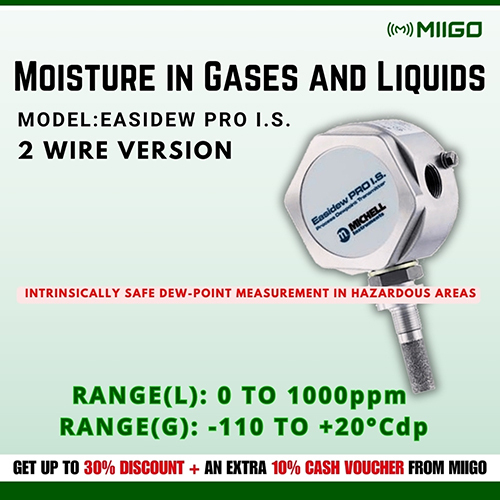
MODEL: EASIDEW PRO I.S.2 WIRE VERSIONIntrinsically Safe Dew-Point Measurement in Hazardous AreasFeatures: - ACCURACY: ±1 Cdp
- RANGE(L): 0 TO 1000ppm
- RANGE(G): -110 TO +20Cdp
- PRESSURE RATING: 450 barg
- Oxygen Service cleaned
- Traceable 13-point calibration certificate
- ATEX, IECEx, UKCA, cQPSus, TR CU Ex certified
Reliable Dew Point Measurement in Hazardous AreasThe Easidew Pro I.S. is built for harsh, hazardous environments requiring precise dew point monitoring. Its explosion proof certifications (ATEX, IECEx, CSA) ensure compliance and safety in industries such as petrochemical, pharmaceutical, and industrial gas production. The stainless steel 316 construction and IP66 rating offer lasting protection against dust and water ingress, making operations seamless and secure.
Superior Accuracy and Fast ResponseEquipped with an advanced aluminum oxide sensor, this transmitter delivers reliable readings with 2C accuracy and excellent repeatability (0.5C dew point). Its rapid response time (T95 < 60 seconds) minimizes downtime, enabling timely corrective action in moisture-critical processes. Each unit is calibrated to national standards, ensuring you receive results you can trust.
Flexible Installation and Effortless IntegrationThe Easidew Pro I.S. features a compact, loop-powered design compatible with 4-20 mA output for easy integration into existing monitoring or control systems. Mounting options include ISO 1/2" BSP and G1/2" BSP or NPT process connections. The transmitter supports both M12 and 5-pin connector types, suiting your operational requirements while simplifying installation in tight or demanding plant locations.
FAQ's of Easidew Pro I.S. Dew Point Transmitter:
Q: How do I install the Easidew Pro I.S. Dew Point Transmitter in my process line?
A: The transmitter can be easily installed using ISO 1/2" BSP or optional G1/2" BSP/NPT mounting threads. For electrical connections, choose either the M12 or 5-pin connector, ensuring compatibility with your existing setup. Its compact form and robust 316 stainless steel housing enable installation even in confined industrial areas.
Q: What makes the Easidew Pro I.S. suitable for hazardous area applications?
A: It holds explosion proof certifications including ATEX, IECEx, and CSA (EEx ia IIC T4), meaning it meets stringent safety requirements for intrinsically safe equipment. The rugged, stainless steel construction and IP66/NEMA 4X ingress protection further safeguard performance in environments with dust, water, or potentially explosive atmospheres.
Q: When should I use this transmitter for dew point measurement?
A: Deploy the Easidew Pro I.S. whenever reliable moisture detection in industrial compressed air or process gases is critical-especially where intrinsic safety is a requirement, such as chemical plants, oil & gas refineries, or pharmaceutical manufacturing facilities.
Q: Where can the Easidew Pro I.S. be used and what media is it compatible with?
A: This transmitter is intended for indoor or outdoor industrial installations. It effectively measures dew point in a variety of gases, including compressed air, making it appropriate for numerous sectors such as petrochemicals, energy, and food processing.
Q: What are the main benefits of using this dew point transmitter?
A: Key advantages include high measurement accuracy (2C dew point), fast response time (T95 < 60 seconds), excellent repeatability, and long-term stability. The intrinsically safe ratings and traceable calibration guarantee micro moisture control in hazardous environments, improving process reliability and safety.
Q: How does the transmitter communicate dew point readings without a display?
A: The Easidew Pro I.S. outputs a continuous 4-20 mA signal, which can be easily interpreted and logged by standard industrial monitoring systems or PLCs. This ensures realtime, remote access to critical moisture data without the need for an onboard display.
Q: What is the process for maintaining calibration and traceability?
A: Each unit comes factory calibrated against national standards with documentation for traceability. For ongoing maintenance, periodic recalibration is recommended depending on your application's requirements; this helps ensure continued accuracy and regulatory compliance.